
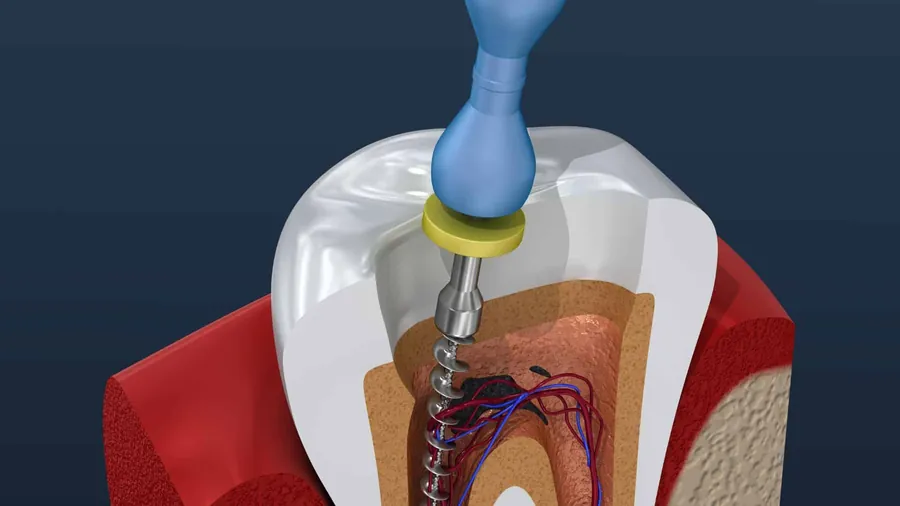
What is root canal treatment?
Under the hard outer layer of every tooth is a chamber and a set of narrow canals that hold the dental pulp — soft tissue containing nerves and blood vessels. When decay, deep injury or infection reaches that tissue, the tooth can become tender, throbbing or sensitive, and the tissue inside cannot heal by itself.
Root canal treatment, also called endodontic treatment, removes the inflamed or infected tissue from inside the tooth. The chamber and canals are then cleaned, shaped, disinfected and sealed. Once the tooth is sealed and restored, it stays in place and can continue to function as part of your bite. Retaining the natural tooth is usually preferable to extracting it.
Because the pulp tissue is where the tooth's nerve supply sits, treating it also removes the source of the pain — while the tooth itself and its supporting structures remain yours.
Who may need this treatment
Root canal treatment may be considered when:
- A tooth is persistently painful, throbbing or wakes you at night.
- A tooth is highly sensitive to hot or cold and the sensitivity lingers.
- Deep decay has reached the pulp inside the tooth.
- A tooth has been fractured or injured and the pulp is exposed or damaged.
- A dental abscess, gum swelling or a bad taste suggests infection from a tooth.
- A tooth needs to be saved rather than removed, including as support for a future restoration.
The treatment process
Examination and diagnosis
The tooth is examined, tested for sensitivity to cold, pressure and tapping, and imaged with radiographs so the dentist can see the shape of the roots and canals and confirm the source of the problem.
Making the procedure comfortable
Local anaesthesia is used so that the tooth and surrounding tissue are numb during treatment. Let your dentist know if you feel anything at any point, and it will be addressed before work continues.
Access and cleaning
A small opening is made through the top of the tooth. The inflamed or infected tissue is removed, and the canals are cleaned and shaped with fine instruments so that they can be thoroughly disinfected.
Sealing the root canal system
The canals are filled and sealed with a rubber-like material so that micro-organisms cannot re-enter. The opening is closed with a temporary or permanent filling.
Restoring the tooth
Many back teeth that have had root canal treatment are then protected with a crown or an onlay, because a tooth can become more brittle once its inner tissue has been removed. Your dentist will advise what the tooth needs.
Benefits of treatment
The natural tooth and its root stay in the jaw, preserving your bite and the bone around it.
Removing the inflamed or infected tissue at the centre of the problem relieves the pain the tooth has been causing.
Keeping the tooth in place helps neighbouring teeth stay in position and keeps chewing comfortable.
A treated tooth can often continue to serve you, which may mean an extraction and its replacement can be avoided.
Precision that comes from seeing more
Root canals are narrow, curved and sometimes very fine. Working accurately inside them is greatly helped by magnification and by good illumination, which let the dentist see the canal openings, follow the canal path and check that cleaning is thorough.
Pre-treatment radiographs are used to understand root anatomy before instrumentation begins, and intra-operative imaging helps confirm instrument position and length. Small, flexible rotary instruments allow canals to be cleaned and shaped efficiently with less unnecessary widening.

- Diagnostic imaging before treatment, not guesswork
- Magnification and directed illumination during treatment
- Fine instruments matched to the anatomy of the canal
- Sealing verified before the tooth is restored
How we keep treatment manageable
Comfort is a clinical decision, not a courtesy — it shapes how treatment is planned and how it is carried out.
Questions About Root Canal Treatment
The questions patients ask most often about this treatment, answered directly.
Does root canal treatment hurt?
The tooth is numbed with local anaesthesia before treatment starts, and the inflamed tissue that is causing the pain is what the treatment removes. Sensitivity afterwards is usually related to the tissues around the tooth settling, and your dentist will tell you what to expect and how to manage it. If you feel discomfort at any point during treatment, tell your dentist immediately.
How many visits does it take?
It varies. Some teeth can be completed in a single visit, while teeth with multiple canals, infection, re-treatment needs or complex anatomy may need more than one appointment. Your dentist will explain the plan for your particular tooth.
Will I need a crown afterwards?
Often a back tooth that has had root canal treatment is protected with a crown or an onlay, because a tooth can be more prone to fracture once its inner tissue has been removed. Whether yours needs one depends on how much sound tooth structure remains, and you will be advised at consultation.
What if I delay treatment?
An infected pulp does not heal on its own, and symptoms can settle temporarily before returning. Delaying assessment can allow infection to progress and may reduce the options for keeping the tooth. If you have facial swelling, difficulty swallowing or fever, seek care without delay.