

What is smile design?
Smile design is a planning process. Photographs, measurements and, where appropriate, a digital mock-up are used to study how your teeth, gum line, lips and facial proportions work together. From that, a plan is drawn for any change — which teeth, in what shape, shade and position — before treatment begins.
The purpose is predictability and restraint. Teeth that are lengthened, whitened or reshaped individually can look out of place; teeth planned as a set look natural. Planning also lets you see the proposed direction before irreversible work is done.
Smile design itself is not a single procedure. It is a framework that may include whitening, composite bonding, veneers, crowns, gum contouring or orthodontics, chosen according to what your smile actually needs.
Who may need this treatment
Smile design may be helpful when:
- You are unhappy with the colour, shape or size of your front teeth.
- Teeth appear worn, chipped, uneven or differently sized.
- Gaps or crowding affect the appearance of the front teeth.
- The gum line looks uneven when you smile.
- An old restoration or crown no longer matches your other teeth.
- You want to know what is realistic before committing to cosmetic treatment.
The treatment process
Consultation and photographs
You discuss what bothers you about your smile. Clinical photographs, measurements and an examination record how your teeth, gums and lips currently relate.
Digital planning and mock-up
A planned result is worked out from the records and shown to you as a visual proposal. Some cases can be previewed in the mouth with a temporary mock-up.
Agreeing the plan
The proposed treatment, the sequence, the alternatives, the limitations and the commitment involved are discussed, and you decide whether to proceed.
Preparatory treatment
Any decay, gum inflammation or bite problem is treated first, because cosmetic work depends on a healthy foundation.
Carrying out the treatment
Whitening, bonding, veneers, crowns or orthodontics are carried out in the planned sequence, with shade and shape checked at each stage.
Review and maintenance
The result is reviewed once things have settled, and you are shown how to care for it and what will need maintenance over time.
Benefits of treatment
You see the direction of treatment, and why each tooth is being changed, before work starts.
Proportion and shade are matched to your face and remaining teeth rather than to an idealised template.
Bonding or whitening can often achieve a great deal before veneers or crowns are considered.
Shade and outline are recorded and checked at try-in stages, so the final result matches the plan.
Seeing the result before deciding on it
Digital smile planning uses photographs, measurements and a digital mock-up so that the proposed shape and length of the front teeth can be assessed against the face, not just against the mouth. Where it helps, a trial mock-up is placed on the teeth so you can see and feel the proposal first.
Shade matching uses controlled lighting and comparison tabs, because tooth colour changes under different light. Ceramic layering lets a restoration reproduce the translucency and surface texture of natural enamel rather than looking uniformly opaque.
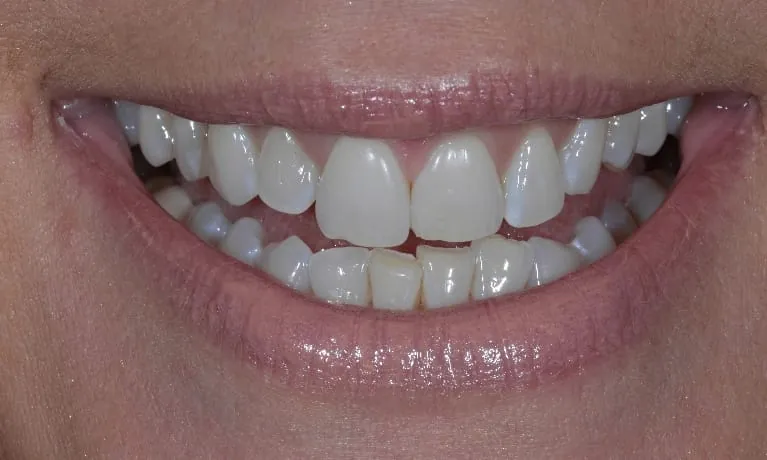
- Clinical photography before and during treatment
- Digital proportion planning against facial reference lines
- Trial mock-up for patient preview where indicated
- Shade verification at try-in and final fitting
- Bite checked so that appearance does not compromise function
A considered, unhurried approach
Comfort is a clinical decision, not a courtesy — it shapes how treatment is planned and how it is carried out.
Questions About Smile Design
The questions patients ask most often about this treatment, answered directly.
Will it look artificial?
That is precisely what planning aims to avoid. The most common cause of an artificial result is treating teeth in isolation — over-bright or over-long individual teeth. Proportion, shade and surface texture are planned against your face and remaining teeth instead.
Which is better: veneers or bonding?
They solve different problems. Composite bonding adds material to reshape a tooth conservatively and can often be repaired; ceramic veneers resist staining better and suit more extensive change but remove a thin layer of enamel permanently. Suitability depends on your teeth.
Do I need whitening before other treatment?
Often a shade change is planned first, because restorations cannot be whitened afterwards and must be matched to the final tooth shade.
Is smile design suitable for everyone?
No. Untreated decay, active gum disease, heavy grinding or an unstable bite need attention first, and in some cases orthodontics is the better route to the change you want. That will be discussed with you at consultation.