
How do braces and aligners move teeth?
Teeth sit in bone that responds to pressure. Applied steadily in the right direction, that pressure causes the bone around a tooth to remodel gradually, allowing the tooth to move. Orthodontic appliances exist to deliver that pressure accurately and continuously.
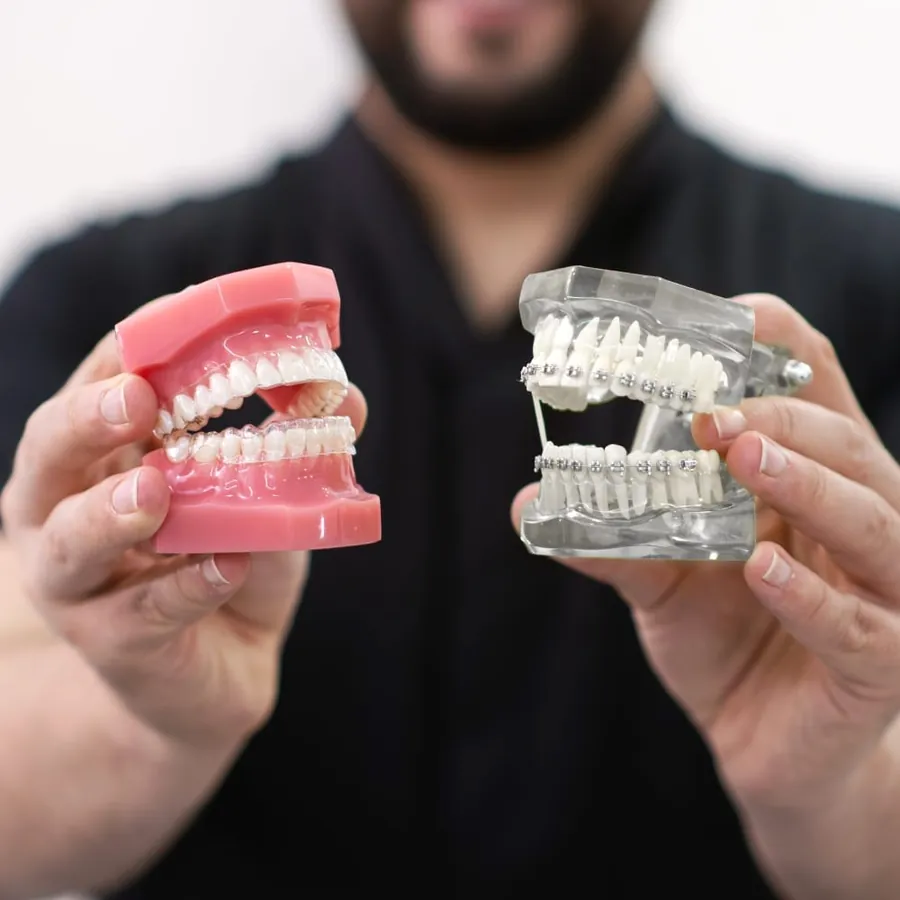
Fixed braces use brackets bonded to the teeth, connected by a wire that guides them toward the planned positions. Clear aligners use a series of removable transparent trays, each of which moves the teeth a small step toward the planned arrangement. Aligners are changed on a schedule set by your dentist and must be worn for the prescribed number of hours each day to work.
Which system suits you depends on the type of correction required, how much movement is needed, your gum health and your willingness to comply with wear time. Some movements are better achieved with fixed appliances; simpler alignment cases often suit aligners well.
Who may need this treatment
Orthodontic treatment may be considered when:
- Teeth overlap, rotate or are unevenly spaced.
- Gaps remain between teeth, whether naturally or after tooth loss.
- The bite feels uneven, or teeth meet differently on one side.
- Front teeth protrude, or the teeth appear crowded as a whole.
- Cleaning is difficult because teeth are hard to reach, leading to repeated decay or gum problems.
- A relapse has occurred after previous orthodontic treatment.
The treatment process
Assessment and records
Clinical examination, radiographs, photographs, impressions or scans, and a bite assessment establish the starting position and the movement required.
Treatment planning
The plan defines which teeth move, in what order and by how much, and which appliance will deliver it. Where appropriate you are shown an expected progression.
Beginning treatment
For fixed braces, brackets are bonded and the first wire is placed. For aligners, the first trays are fitted, along with attachments where required.
Regular adjustments and review
Braces are adjusted at intervals as the wire sequence progresses. Aligners need monitoring to confirm the teeth are tracking as planned.
Finishing and retention
Once the teeth have reached their planned positions, the appliance is removed and a retainer is provided. Retention is a permanent part of orthodontics, because teeth can drift back over the years.
Benefits of treatment
Straight teeth and a balanced bite make everyday oral hygiene more effective.
Correcting how the teeth meet distributes biting forces more predictably across the dental arch.
The most visible benefit is usually the appearance of the smile, which many patients find affects confidence.
Where restorations or replacements are planned, aligning the teeth first can make them simpler and more conservative.
Clear aligners and tooth-coloured brackets reduce the visibility of appliances during treatment.
Planning the movement, then monitoring it
Orthodontics is a sequence, not a single intervention. The teeth are moved in a deliberate order, and each stage depends on the previous one having gone as expected. Planning therefore starts with full records: radiographs, photographs, a bite assessment and, in many cases, a digital scan of the teeth.
Digital scanning lets the planned arrangement be studied and monitored in three dimensions, and for aligner treatment it drives the manufacture of the tray sequence. For fixed appliances, the brackets are positioned from the anatomy of each tooth so that the wire delivers force in the intended direction.
- Records taken before treatment: radiographs, photographs, scans
- Movement plan worked out tooth by tooth and stage by stage
- Progress compared against the plan at each review
- Appliances checked for fracture, looseness or tracking loss
- Retention planned from the start, not added at the end
Settling in, and keeping things manageable
Comfort is a clinical decision, not a courtesy — it shapes how treatment is planned and how it is carried out.
Questions About Braces & Aligners
The questions patients ask most often about this treatment, answered directly.
Which is better, braces or aligners?
It depends on the movement required, not on preference alone. Aligners suit many cases of crowding and spacing well, while some rotations, vertical movements and bite corrections are more reliably achieved with fixed appliances. Your dentist will advise which is more predictable for your case.
Can I eat normally with braces?
Yes, with adjustments. Hard and sticky foods can break brackets or bend wires, so they are usually avoided or cut up. Aligners are removed for eating and for drinking anything other than water.
How long do I have to wear aligners each day?
Aligners only work while they are in the mouth, so wear time matters a great deal. Your dentist will specify the daily hours and the change interval for your tray sequence, and will monitor whether the teeth are tracking.
Will my teeth move back afterwards?
Without retention they can. Teeth continue to shift throughout life, so a retainer — fixed or removable — is used after treatment. Retainers need their own care and periodic checking.